
Last time, we talked about silent inflammation and how it can sit quietly behind stubborn weight gain. If you haven't read that one yet, it's worth starting there, but today I want to go a layer deeper, because understanding why inflammation makes weight loss so much harder is often the missing piece that finally makes everything click.
Here's the line from that last post that I want to unpack: inflammation interferes with insulin signalling, disrupts your hormones, dysregulates your metabolism, and drives fat storage, particularly around the abdomen. Let's break down what's actually happening in your body when that occurs.
The insulin connection
Insulin's job is simple: it knocks on your cells' doors and tells them to let glucose in for energy. When you have chronic low-grade inflammation, inflammatory messengers (called cytokines like TNF-α and IL-6) interfere with that signal, essentially jamming the lock. Your cells stop responding properly, so your pancreas compensates by producing more and more insulin to get the same job done.
The problem is that high circulating insulin is also a powerful fat-storage signal, particularly for visceral fat around your middle. So the more inflamed and insulin-resistant your body becomes, the more it's biologically primed to store fat rather than burn it , no matter how disciplined you are with food and exercise.
Why visceral fat makes things worse, not better
Here's the part that surprises most people: visceral fat isn't just sitting there. It behaves like an active endocrine organ, pumping out its own inflammatory cytokines. In people carrying excess visceral fat, this tissue alone can be responsible for a large share of the inflammatory chemicals circulating in the blood. This creates a feedback loop researchers call "metaflammation": inflammation drives visceral fat storage, and that visceral fat then produces more inflammation, which drives more fat storage. Once this cycle is underway, it's easy to see why the scales won't budge no matter what you try - but the good news is that a cycle like this can be interrupted at more than one point, which is exactly what we'll get into below.
The hormone domino effect
Inflammation rarely stays in its own lane. It can impair the conversion of thyroid hormone from its inactive form (T4) to its active form (T3), slowing metabolic rate, and elevated cortisol compounds this, since stress hormones interfere with that same conversion process. Cortisol also stays elevated and promotes abdominal fat storage more directly, because visceral fat carries a particularly high density of cortisol receptors. And as oestrogen naturally declines through perimenopause, you lose one of your body's most effective natural anti-inflammatory buffers.
It's worth being precise about timing here: insulin sensitivity and lean muscle mass do begin a gradual decline from your mid-30s, which is part of why this picture starts to shift around then. But the sharpest turning point tends to come later, during perimenopause (often the mid-to-late 40s), when the drop in oestrogen really accelerates the inflammatory and metabolic changes we're talking about. So if you're in your late 30s or early 40s and things are already feeling harder, you're not imagining it, you're just further along a curve that steepens later.
Why you're craving sugar and carbs
When your cells become insulin-resistant, glucose struggles to get in even though there's plenty of it in your bloodstream. This leads to your muscle and fat cells being left running short on fuel, even while blood sugar stays high. Inflammation also interferes with leptin, the hormone that tells your brain you're full. Cytokines essentially jam that signal, so your brain doesn't register that you've had enough. Appetite regulation more broadly gets tangled up in the same process, and the result is a genuine physiological pull toward sugar and refined carbs - not a willpower failure.
So how do you actually calm it?
The strategies from the last post - omega-3 rich foods, reducing ultra-processed foods, colourful plants, gut support, and addressing stress and sleep - are exactly where this starts, because they work directly on the mechanisms above: lowering inflammatory cytokines, improving insulin sensitivity, and giving your hormones room to recalibrate.
In practice, that can look like:
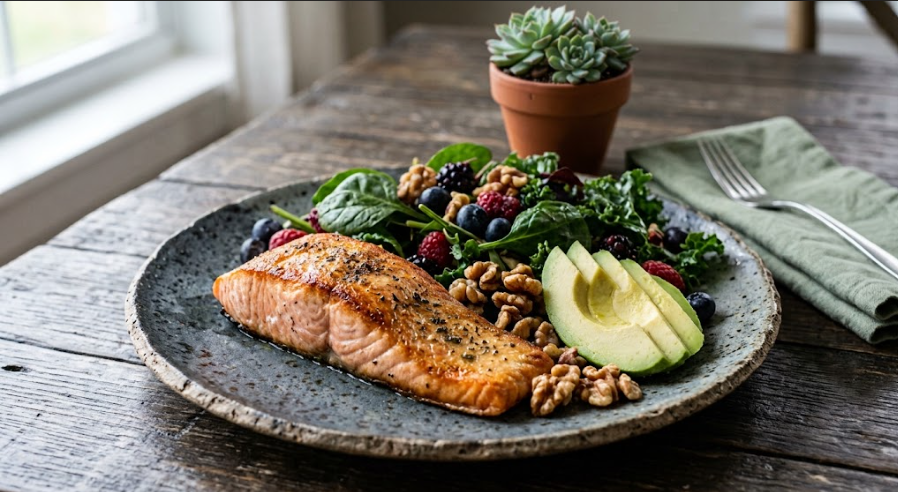
Omega-3 rich foods: oily fish like salmon, sardines and mackerel, plus walnuts and flaxseeds, to help bring down inflammatory messengers like TNF-α and IL-6
Colourful, polyphenol-rich plants: berries, leafy greens and cruciferous veg like broccoli and cauliflower, which support your liver's ability to clear excess hormones and calm inflammation
Gut-supportive foods: fermented foods like sauerkraut and kefir, plus plenty of fibre, since gut health has a direct line to both inflammation and hormone balance
Magnesium glycinate: often under-recognised, but magnesium supports insulin sensitivity, helps regulate cortisol, and is calming on the nervous system, all relevant when you're trying to break a stress-driven cycle
A quality B-complex: B vitamins are essential for supporting your body through the physiological load of chronic stress
But because this feedback loop involves so many interacting systems - insulin, cortisol, thyroid, oestrogen, gut health - generic advice (even a good food and supplement list) often isn't enough to break it on its own. This is where understanding your own specific drivers, through the right testing and a personalised plan, makes the real difference.
If you're ready to understand exactly what's driving this cycle in your body and build a plan that actually works with your physiology, I'd love to help. Book your free Health Clarity Call and let's get to the root of it together → [Book your Health Clarity Call here]