You're eating the same way you always have. Moving the same amount. Sleeping roughly the same hours. So why has your body suddenly stopped responding the way it used to?
If you're in your 40s or early 50s and the approach that used to work for you has simply stopped working, you're not imagining it, and you haven't done anything wrong. Something genuinely has changed, and it's worth understanding what, because it changes what actually helps.
It's not you, it's the rules that have changed
Perimenopause doesn't move in one smooth, steady line. In the earlier stages, oestrogen tends to go on something more like a roller coaster, swinging between extreme highs and extreme lows rather than gradually tapering off. It's only in the later stages of perimenopause that oestrogen really starts to drop away.
That later decline matters because oestrogen does far more than regulate your cycle. It plays a direct role in how your body manages insulin, where it prefers to store fat, and how quickly you build and maintain muscle.
As oestrogen falls in this later stage, its support for healthy insulin regulation falls with it, and this is often when women who have always had normal glucose management start to notice more insulin resistance creeping in. That shift is a big part of why fat storage tends to increase around this time, and why it settles more around the middle rather than the hips and thighs.
Cortisol, your stress hormone, adds another layer on top of this. During this stage of life, background cortisol levels tend to rise, and the natural daily rhythm, higher in the morning and lower by night, tends to flatten out, with cortisol staying elevated later into the evening.
Higher evening cortisol has been linked to increased storage of visceral fat around the midsection, and it can also reduce insulin sensitivity, compounding the resistance that's already building from the drop in oestrogen.
At the same time, muscle mass naturally declines with age, and this decline speeds up during perimenopause, as falling oestrogen means less support for building and repairing muscle. Since muscle is one of the biggest drivers of your metabolic rate, less muscle means fewer calories burned at rest, even if everything else in your day looks identical.
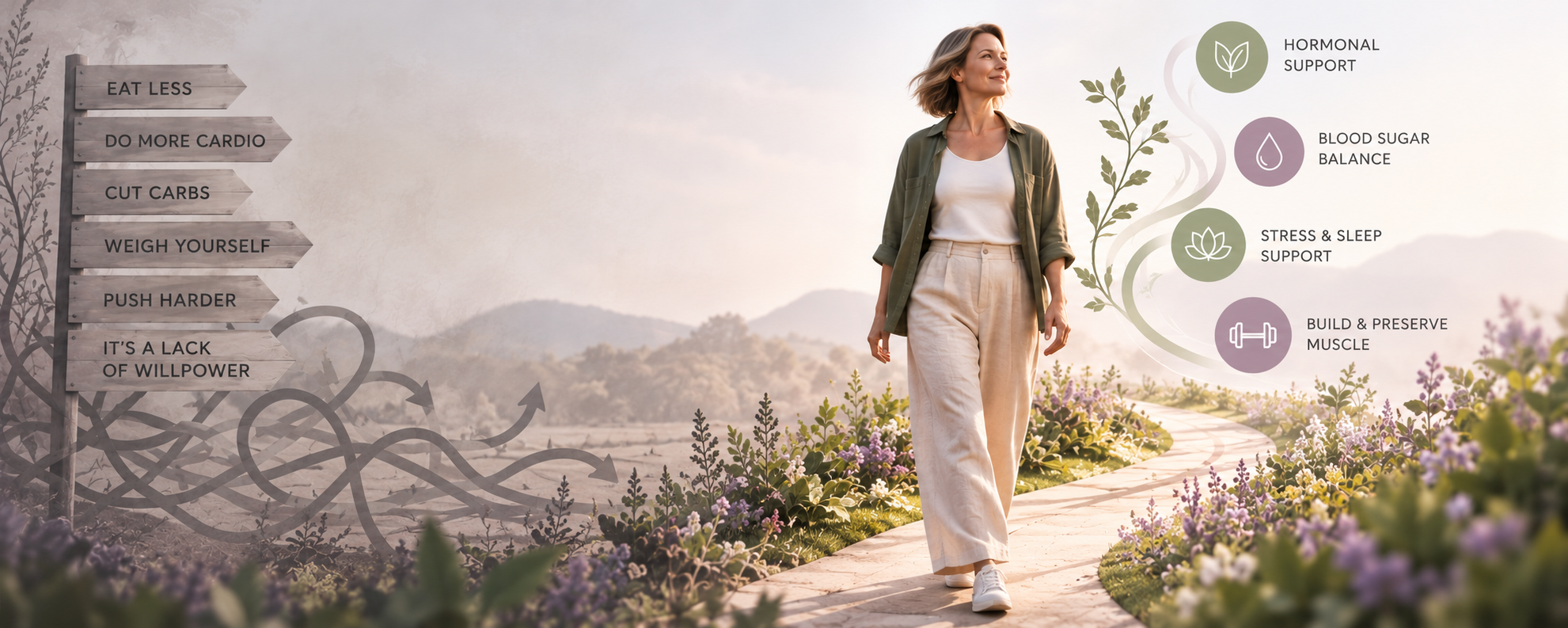
None of this is about willpower or doing something wrong. It simply means the strategy needs to evolve alongside your hormones.
What actually helps once the rules have changed
The good news is that once you understand what's shifted, there's a lot you can do.
Prioritise protein at every meal. Aiming for a palm-sized portion of protein at breakfast, lunch and dinner helps preserve muscle mass and keeps blood sugar steadier, which in turn helps manage hunger and energy through the day.
Bring strength training into the mix. If your movement has mostly been cardio-based, adding two to three sessions of resistance training a week can help rebuild the muscle that supports your metabolism, even starting with just bodyweight or light weights.
Support your blood sugar balance across the day. Protein and fibre together are the real winning combination here. Piling your plate with plenty of fresh fruit and vegetables alongside your protein, rather than eating carbohydrates on their own, helps blunt the post-meal glucose rise and smooths out the insulin response that's become more sensitive during this stage.
Protect your sleep and keep an eye on stress. Cortisol and blood sugar are closely linked, so even small improvements to sleep quality and stress recovery can make a genuine difference to how your body is holding onto weight.
The takeaway
Perimenopause doesn't mean weight loss becomes impossible. It means the rules that worked before need a hormonal update, and once you're working with your body's new normal rather than the old playbook, real progress becomes possible again.
If you'd like to understand exactly what's driving your own weight loss resistance, whether that's oestrogen decline, insulin resistance, cortisol, thyroid function or a combination, my free Metabolism Detective Quiz will help you pinpoint it in a few minutes. [Take the quiz here →]