
You’re eating well. You’ve cut back on sugar, watched your portions, and you’re moving your body consistently.
And yet — the weight won’t budge. If anything, it feels like your body is gripping tighter, especially around your middle.
By the time many women come to see me, they’re exhausted and frustrated. They’ve tried calorie counting, intermittent fasting, cutting carbs, more cardio — and nothing seems to work the way it used to.
Here’s what I often tell them: it may not be your diet. It may be your stress load.
Your Body Prioritises Survival Over Slimming
Weight loss isn’t just about calories in versus calories out. At a deeper level, it’s about whether your body feels safe enough to let go of stored energy.
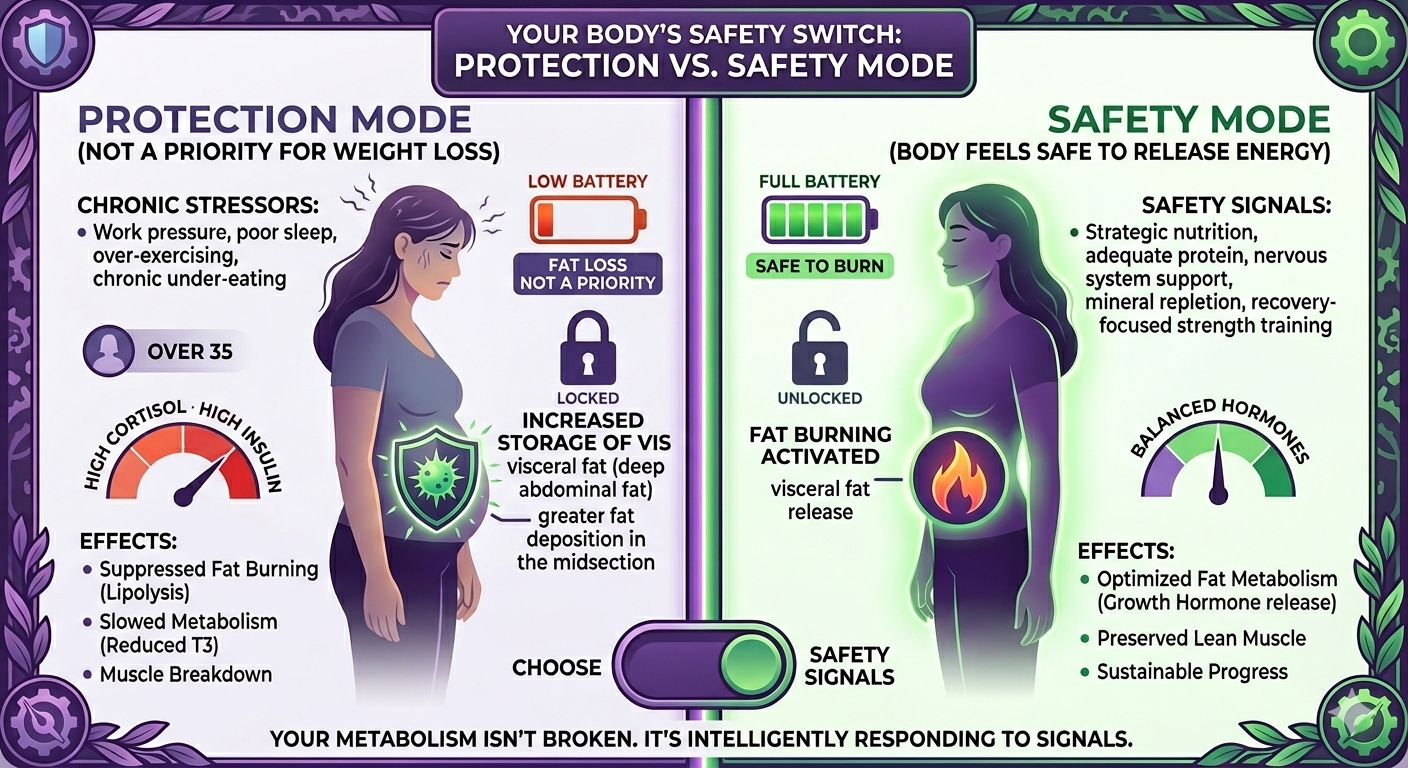
When your nervous system perceives a threat — whether that’s work pressure, emotional strain, poor sleep, over-exercising, or even chronic under-eating — it shifts into protection mode. And in protection mode, fat loss simply isn’t a priority.
The result? A metabolism that’s working against your efforts, not with them. Let me explain why.
1. Cortisol and That Stubborn Belly Fat
Cortisol is your primary stress hormone — and in short bursts, it’s actually helpful. The problem is chronic elevation. When cortisol stays high day after day, your metabolism pays the price.
Persistently elevated cortisol is associated with:
Increased storage of visceral fat (the deep abdominal fat around your organs)
Greater fat deposition in the midsection
Muscle protein breakdown
A shift toward energy conservation — the opposite of what you want
Visceral fat is metabolically active tissue — it responds strongly to stress signals. This is why chronic stress so often shows up as central weight gain that won’t shift no matter what you try.
Here’s something that surprises many of my clients: chronic calorie restriction can also elevate cortisol. When you’re already running on empty, eating less and training harder can compound the stress burden — and actually encourage more visceral fat storage.
2. Stress Disrupts Blood Sugar — and Blocks Fat Burning
Cortisol raises blood glucose by stimulating the liver to produce more sugar (a process called gluconeogenesis) and by reducing insulin sensitivity. In an acute stressful moment, this is adaptive — your body needs quick fuel.
But when stress is ongoing, blood glucose rises frequently — and so does insulin. And here’s the key: when insulin is elevated, fat burning (lipolysis) is suppressed.
This is often why women experience:
Afternoon energy crashes
Intensified sugar cravings
Waking at 2–3am, alert and unsettled
Gradual weight gain despite eating well
Over time, this pattern can contribute to insulin resistance — particularly in women over 35, where insulin sensitivity may already be naturally declining.
3. Stress Quietly Slows Your Thyroid
The thyroid is exquisitely sensitive to stress. Chronic physiological stress can reduce the conversion of inactive T4 into active T3 (the hormone that actually drives metabolism), increase reverse T3, and lower your overall metabolic rate.
Women often describe this as:
Persistent fatigue despite adequate sleep
Cold hands and feet
Brain fog
Weight loss that’s stalled — even with “normal” thyroid labs
This is an important clinical nuance: standard thyroid tests may return “normal” while you’re still experiencing real, measurable symptoms. In perimenopause, this stress-thyroid interaction can become even more pronounced.
4. Poor Sleep Keeps the Cycle Going
Chronic stress and disrupted sleep are deeply intertwined. Elevated evening cortisol interferes with slow-wave (deep) sleep — and reduced deep sleep has its own metabolic consequences.
Poor deep sleep:
Impairs growth hormone release (which supports fat metabolism and tissue repair)
Worsens insulin sensitivity
Increases ghrelin — your hunger hormone
Reduces leptin — your satiety signal
Stress disrupts sleep. Poor sleep raises cortisol. Elevated cortisol further disrupts sleep. It’s a cycle — and it has to be interrupted at the root.
Why This Gets Harder After 35
In perimenopause, oestrogen and progesterone begin to fluctuate and gradually decline. These hormones do far more than regulate your cycle, they also buffer the stress response.
As they shift:
Cortisol responses can feel amplified
Sleep becomes more fragile and easily disrupted
Visceral fat deposition becomes more likely
Insulin resistance risk increases
This is also the stage where metabolic flexibility naturally declines. The strategies that worked in your 20s, like cutting calories hard & adding more cardio, can now increase your physiological stress load and slow progress further.
This isn’t a discipline issue. It’s a neuroendocrine shift.
Does This Sound Familiar?
Stress may be the hidden driver behind your weight loss resistance if you’re experiencing:
Weight gain predominantly around your abdomen
That “wired but tired” feeling that won’t go away
Waking between 2–3am, mind racing
Afternoon energy crashes
Cold hands and feet
Thyroid symptoms with “normal” labs
Doing everything right — and seeing little result
If this resonates, your metabolism may not need more restriction. It may need less stress signalling.
The Shift: From Forcing Fat Loss to Restoring Safety
In my clinic, we don’t begin with calorie reduction. We begin with stabilisation. This creates the physiological conditions in which your body feels safe enough to let go of stored fat.
That approach often includes:
Adequate protein to preserve lean muscle mass
Blood sugar regulation through strategic nutrition timing
Nervous system support — often overlooked, always impactful
Mineral repletion (particularly magnesium, potassium, and sodium balance)
Strength training with genuine recovery built in
Nutrition aligned to your hormonal stage
The goal is to lower chronic stress signalling so your body receives a different message — one that says it’s safe to burn, not store.
Your Metabolism Isn’t Broken
If you’re over 35, eating well, moving consistently and still struggling — it’s time to look deeper. Your body isn’t working against you. It’s responding intelligently to the signals it’s receiving.
When we change those signals, outcomes change.
Take my Metabolism Detective Quiz to discover whether stress, thyroid function, insulin resistance, or perimenopausal shifts may be driving your results. Because once you understand the signals, you can start working with your body — not against it. For Access to the Quiz, click the Metabolism Detective tab on the home page.